 Continue with Google
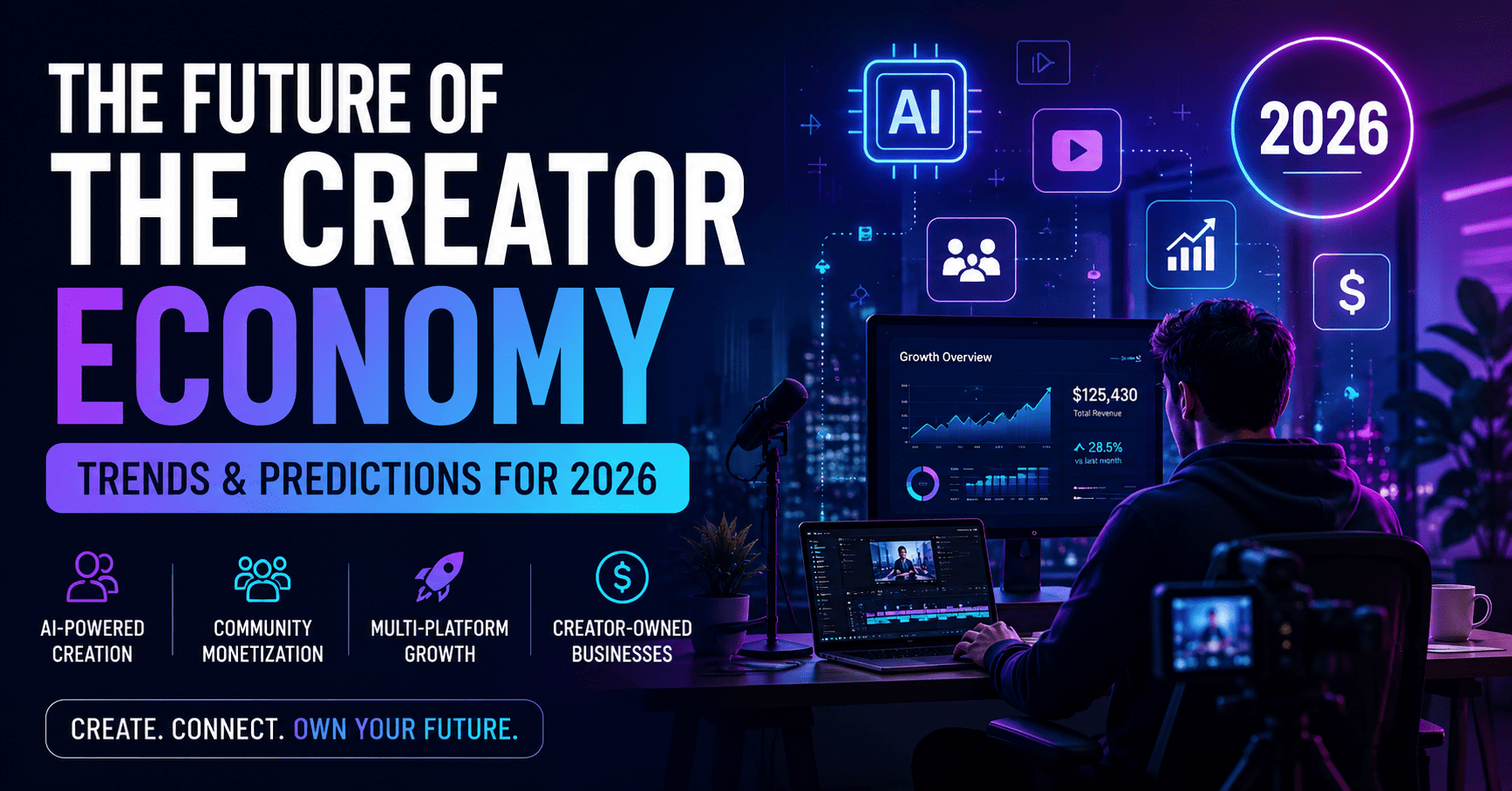
The Future of the Creator Economy: Trends and Predictions for 2026
The creator economy is no longer a side hustle ecosystem. In 2026, it’s becoming a parallel economy — one where independent creators build media companies, launch products, own audiences, and compete directly with traditional brands.
What’s changing fastest is not the number of creators. It’s how creators make money, how audiences behave, and how platforms distribute attention.
The creators who thrive in 2026 won’t necessarily be the biggest influencers. They’ll be the ones who understand leverage, community ownership, AI-assisted production, and multi-platform resilience.
If you’re a creator, marketer, founder, or investor, this guide breaks down the most important creator economy trends shaping 2026 — and what they mean for the future of digital business.
Why the Creator Economy Is Entering a New Era
For years, creators relied heavily on advertising revenue and platform algorithms. That model is weakening.
Today, audiences are fragmented across short-form video, newsletters, podcasts, private communities, live streams, and AI-powered content platforms. At the same time, creators are becoming less dependent on traditional sponsorships.
The biggest shift is this:
Creators are evolving from content producers into asset owners.
Instead of simply chasing views, creators are building:
Subscription communities
Digital products
Membership ecosystems
Educational brands
Niche media businesses
AI-powered content systems
Personal IP portfolios
This transition is turning the creator economy into one of the most influential sectors of modern entrepreneurship.
The 2026 Creator Flywheel Framework
One pattern keeps appearing among fast-growing creators in 2026. I call it the Creator Flywheel Framework.
Instead of relying on one platform or income source, successful creators build a self-reinforcing ecosystem.
The Creator Flywheel Has 5 Layers
Layer | Purpose | Example |
|---|---|---|
Attention | Reach new audiences | TikTok, YouTube Shorts |
Trust | Build authority | Long-form YouTube, podcasts |
Community | Deepen relationships | Discord, Circle, Telegram |
Ownership | Control audience access | Email lists, apps |
Monetization | Generate revenue | Courses, products, memberships |
Most creators fail because they stop at attention.
In 2026, attention without ownership is becoming dangerous. Algorithms change overnight. Platforms lose reach. Ad revenue fluctuates.
Creators who survive long term are building direct audience relationships.
Trend #1: AI Will Become a Creative Operating System
AI is no longer just a productivity tool. In 2026, it’s becoming the infrastructure behind content creation.
Creators now use AI for:
Script ideation
Thumbnail generation
Video editing
Research synthesis
Voice cloning
Personalized audience responses
Automated publishing workflows
But here’s the twist most people miss:
AI Will Reward Personality, Not Replace It
Generic AI-generated content is already flooding platforms. Audiences are getting better at spotting low-effort material.
That means creators with:
distinctive opinions,
storytelling ability,
niche expertise,
humor,
or strong personal brands
will become even more valuable.
The creators winning in 2026 are combining:
AI speed
with human originality
That combination creates scale without losing authenticity.
What Smart Creators Are Doing
Instead of using AI to replace themselves, they use it to:
eliminate repetitive tasks,
test ideas faster,
and increase publishing consistency.
This is why solo creators can now compete with full media teams.
Trend #2: Niche Creators Will Outperform Mass Influencers
The “million-follower dream” is losing relevance.
In 2026, niche creators are becoming dramatically more profitable than broad lifestyle influencers.
Why?
Because trust converts better than reach.
A creator with:
25,000 highly engaged followers
can often earn more than someone with:2 million passive followers.
Micro-Communities Are the New Internet
The internet is splintering into smaller interest-based ecosystems.
Examples include:
AI productivity communities
Finance creators for freelancers
Fitness for remote workers
Parenting creators for tech families
Hyper-local travel creators
Educational creators for niche software tools
Brands increasingly prefer niche creators because:
audiences trust them more,
conversion rates are higher,
and sponsorships feel more authentic.
Prediction for 2026
Expect “creator specialization” to accelerate.
General creators will struggle unless they have celebrity-level reach.
Niche expertise will become the most valuable form of digital authority.
Trend #3: Community-Led Monetization Will Explode
Ad revenue alone is becoming unstable.
The strongest creator businesses in 2026 are community-first businesses.
Instead of monetizing attention once, creators monetize relationships repeatedly.
The Membership Economy Is Growing Fast
Creators are launching:
private communities,
mastermind groups,
premium newsletters,
coaching circles,
and paid educational ecosystems.
This works because audiences increasingly want:
interaction,
belonging,
access,
and transformation.
Content alone is becoming commoditized.
Community is harder to replicate.
Trend #4: Multi-Platform Creators Will Dominate
Relying on one platform in 2026 is risky.
Creators who depended entirely on one algorithm have already experienced:
sudden reach drops,
demonetization,
account suspensions,
or declining engagement.
The new strategy is platform diversification.
The “Content Layering” Strategy
Top creators now repurpose one idea into multiple formats.
For example:
Platform | Content Format |
|---|---|
YouTube | Long-form educational video |
TikTok | Quick insight clip |
X/Twitter | Thread summary |
Professional insight | |
Newsletter | Deep analysis |
Podcast | Expanded discussion |
One idea becomes six distribution assets.
This dramatically increases reach while reducing creative burnout.
Trend #5: Creator-Owned Products Will Replace Sponsorship Dependence
Sponsorships still matter, but creators increasingly want ownership-based income.
Why?
Because sponsorships cap earnings.
Owned products scale.
The Rise of Creator Brands
Creators are launching:
SaaS tools,
skincare brands,
templates,
educational products,
productivity apps,
fashion labels,
and niche software.
The creator becomes the distribution engine.
This is a major shift in digital business strategy.
In many industries, creators now outperform traditional advertising because they already have trust.
What Changes in 2026
Audiences are becoming more skeptical of random ads.
But they still buy from creators they trust consistently.
That trust is becoming a competitive advantage larger companies struggle to replicate.
Trend #6: Educational Creators Will Become the Biggest Winners
Entertainment remains powerful, but educational creators are quietly building some of the strongest businesses online.
Why?
Because education has:
measurable outcomes,
high monetization potential,
and recurring demand.
Creators teaching:
AI workflows,
coding,
design,
business systems,
finance,
health optimization,
and communication skills
are building highly profitable ecosystems.
The “Learning Commerce” Boom
In 2026, education is blending with commerce.
Creators are monetizing through:
cohort-based courses,
paid communities,
certification systems,
consulting,
templates,
and AI-assisted coaching.
People increasingly trust creators more than institutions for practical learning.
That trend is accelerating fast.
Trend #7: Authenticity Will Become a Premium Asset
Audiences are exhausted by polished perfection.
The next era of the creator economy rewards:
transparency,
depth,
and human relatability.
Creators who openly share:
failures,
experiments,
behind-the-scenes processes,
and nuanced opinions
are building stronger audience loyalty.
“Human Signals” Matter More in 2026
As AI-generated content increases, audiences seek:
personality,
emotional connection,
and lived experience.
Ironically, the rise of AI is making human authenticity more valuable.
This is why creators who sound overly corporate or artificial are losing engagement.
Common Mistakes Creators Will Make in 2026
Many creators are still using outdated growth strategies.
Here are the biggest mistakes likely to hurt growth:
1. Over-Relying on Viral Content
Virality is unpredictable. Sustainable creators focus on systems and audience retention.
2. Ignoring Email Lists
Social followers are rented audiences. Email subscribers are owned audiences.
3. Chasing Every Platform
Spreading too thin destroys quality and consistency.
4. Using AI Without Originality
Generic AI content blends into the noise quickly.
5. Monetizing Too Late
Creators often wait too long before building products or communities.
What the Creator Economy Will Look Like by 2030
The trends emerging in 2026 point toward a larger transformation.
By 2030, we’ll likely see:
creators operating full digital companies,
AI-powered solo entrepreneurs,
creator-owned media networks,
decentralized community platforms,
and audience-owned monetization models.
The line between:
creator,
entrepreneur,
educator,
and media company
will almost disappear.
The most successful creators won’t simply “post content.”
They’ll build ecosystems.
Final Thoughts
The future of the creator economy isn’t about chasing followers anymore.
It’s about:
owning attention,
building trust,
creating communities,
and developing scalable assets.
The creators who win in 2026 will think like founders, not influencers.
They’ll use AI strategically without sacrificing originality. They’ll prioritize niche authority over vanity metrics. And most importantly, they’ll build direct relationships with audiences instead of relying entirely on algorithms.
The creator economy is still early.
But the easy-growth era is ending.
The next generation of creators will need:
stronger positioning,
deeper expertise,
smarter monetization,
and genuine audience connection.
Those who adapt now could build businesses that remain relevant for the next decade.