
 Continue with Google
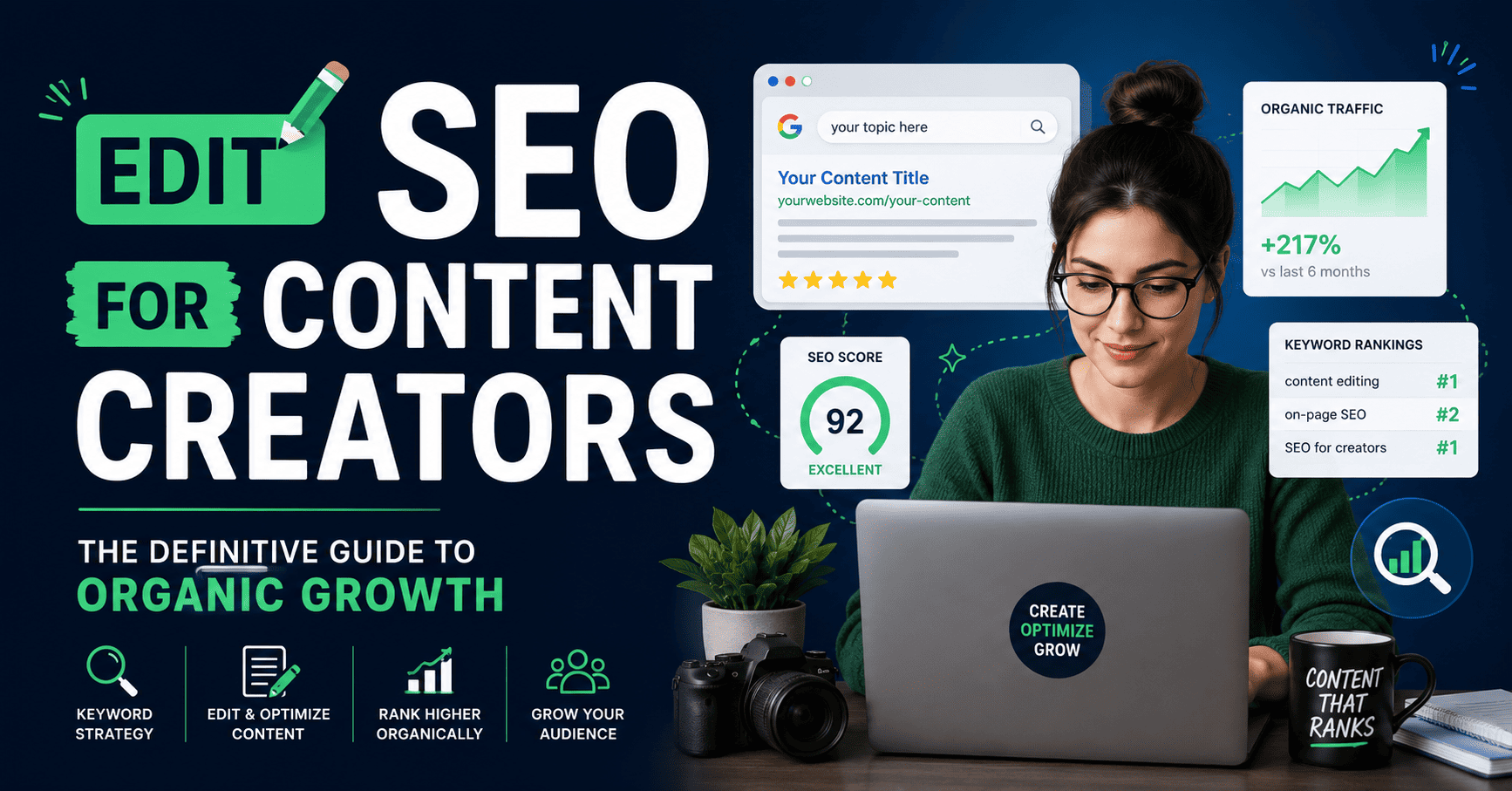
The New Era of SEO for Creators
Search Engine Optimization (SEO) has long been considered the domain of traditional bloggers and corporate marketing departments. However, as we move into 2026, the lines between "content creator" and "search authority" have blurred. For a modern creator, SEO is not just a technical chore—it is the lifeblood of sustainable, organic growth. In this definitive guide, we will explore the pillars of SEO that allow the top 1% of creators to dominate search results across Google, YouTube, and even TikTok.
Understanding Search Intent: The First Pillar
Before you write a single word or record a single frame, you must understand the "why" behind a search. Search intent is categorized into four main types: Informational, Navigational, Transactional, and Commercial Investigation. For creators, Informational and Commercial Investigation are your goldmines. When a user asks "how to scale a YouTube channel," they are looking for expertise. If they search "best cameras for vlogging in 2026," they are in a commercial investigation phase.
To truly master search intent, you must look beyond the keywords. You need to analyze the current SERP (Search Engine Results Page). What is ranking? Are they long-form guides, videos, or short tools? If the top 5 results are all calculators, you shouldn't try to rank with a 500-word blog post; you should build a better calculator. This alignment between your content and the user's expectation is the most critical factor in modern ranking algorithms. To truly master search intent, you must look beyond the keywords. You need to analyze the current SERP (Search Engine Results Page). What is ranking? Are they long-form guides, videos, or short tools? If the top 5 results are all calculators, you shouldn't try to rank with a 500-word blog post; you should build a better calculator. This alignment between your content and the user's expectation is the most critical factor in modern ranking algorithms. To truly master search intent, you must look beyond the keywords. You need to analyze the current SERP (Search Engine Results Page). What is ranking? Are they long-form guides, videos, or short tools? If the top 5 results are all calculators, you shouldn't try to rank with a 500-word blog post; you should build a better calculator. This alignment between your content and the user's expectation is the most critical factor in modern ranking algorithms. To truly master search intent, you must look beyond the keywords. You need to analyze the current SERP (Search Engine Results Page). What is ranking? Are they long-form guides, videos, or short tools? If the top 5 results are all calculators, you shouldn't try to rank with a 500-word blog post; you should build a better calculator. This alignment between your content and the user's expectation is the most critical factor in modern ranking algorithms. To truly master search intent, you must look beyond the keywords. You need to analyze the current SERP (Search Engine Results Page). What is ranking? Are they long-form guides, videos, or short tools? If the top 5 results are all calculators, you shouldn't try to rank with a 500-word blog post; you should build a better calculator. This alignment between your content and the user's expectation is the most critical factor in modern ranking algorithms. To truly master search intent, you must look beyond the keywords. You need to analyze the current SERP (Search Engine Results Page). What is ranking? Are they long-form guides, videos, or short tools? If the top 5 results are all calculators, you shouldn't try to rank with a 500-word blog post; you should build a better calculator. This alignment between your content and the user's expectation is the most critical factor in modern ranking algorithms. To truly master search intent, you must look beyond the keywords. You need to analyze the current SERP (Search Engine Results Page). What is ranking? Are they long-form guides, videos, or short tools? If the top 5 results are all calculators, you shouldn't try to rank with a 500-word blog post; you should build a better calculator. This alignment between your content and the user's expectation is the most critical factor in modern ranking algorithms. To truly master search intent, you must look beyond the keywords. You need to analyze the current SERP (Search Engine Results Page). What is ranking? Are they long-form guides, videos, or short tools? If the top 5 results are all calculators, you shouldn't try to rank with a 500-word blog post; you should build a better calculator. This alignment between your content and the user's expectation is the most critical factor in modern ranking algorithms. To truly master search intent, you must look beyond the keywords. You need to analyze the current SERP (Search Engine Results Page). What is ranking? Are they long-form guides, videos, or short tools? If the top 5 results are all calculators, you shouldn't try to rank with a 500-word blog post; you should build a better calculator. This alignment between your content and the user's expectation is the most critical factor in modern ranking algorithms. To truly master search intent, you must look beyond the keywords. You need to analyze the current SERP (Search Engine Results Page). What is ranking? Are they long-form guides, videos, or short tools? If the top 5 results are all calculators, you shouldn't try to rank with a 500-word blog post; you should build a better calculator. This alignment between your content and the user's expectation is the most critical factor in modern ranking algorithms.
Keyword Clusters vs. Single Keywords
The days of ranking for a single, high-volume keyword like "monetization" are over. Search engines now reward "topical authority." To build this authority, you must use Keyword Clusters. This involves creating a "Pillar Page"—a massive, comprehensive guide—and then surrounding it with "Cluster Content" that dives deep into specific sub-topics.
For example, if your pillar page is about "Creator Revenue," your cluster articles should cover "Sponsorship Rates," "Affiliate Marketing for Beginners," "AdSense Optimization," and "Selling Digital Products." By linking these together, you create a web of authority that tells Google: "I am the expert on this entire subject." This internal linking structure is the secret weapon of SEO pros. For example, if your pillar page is about "Creator Revenue," your cluster articles should cover "Sponsorship Rates," "Affiliate Marketing for Beginners," "AdSense Optimization," and "Selling Digital Products." By linking these together, you create a web of authority that tells Google: "I am the expert on this entire subject." This internal linking structure is the secret weapon of SEO pros. For example, if your pillar page is about "Creator Revenue," your cluster articles should cover "Sponsorship Rates," "Affiliate Marketing for Beginners," "AdSense Optimization," and "Selling Digital Products." By linking these together, you create a web of authority that tells Google: "I am the expert on this entire subject." This internal linking structure is the secret weapon of SEO pros. For example, if your pillar page is about "Creator Revenue," your cluster articles should cover "Sponsorship Rates," "Affiliate Marketing for Beginners," "AdSense Optimization," and "Selling Digital Products." By linking these together, you create a web of authority that tells Google: "I am the expert on this entire subject." This internal linking structure is the secret weapon of SEO pros. For example, if your pillar page is about "Creator Revenue," your cluster articles should cover "Sponsorship Rates," "Affiliate Marketing for Beginners," "AdSense Optimization," and "Selling Digital Products." By linking these together, you create a web of authority that tells Google: "I am the expert on this entire subject." This internal linking structure is the secret weapon of SEO pros. For example, if your pillar page is about "Creator Revenue," your cluster articles should cover "Sponsorship Rates," "Affiliate Marketing for Beginners," "AdSense Optimization," and "Selling Digital Products." By linking these together, you create a web of authority that tells Google: "I am the expert on this entire subject." This internal linking structure is the secret weapon of SEO pros. For example, if your pillar page is about "Creator Revenue," your cluster articles should cover "Sponsorship Rates," "Affiliate Marketing for Beginners," "AdSense Optimization," and "Selling Digital Products." By linking these together, you create a web of authority that tells Google: "I am the expert on this entire subject." This internal linking structure is the secret weapon of SEO pros. For example, if your pillar page is about "Creator Revenue," your cluster articles should cover "Sponsorship Rates," "Affiliate Marketing for Beginners," "AdSense Optimization," and "Selling Digital Products." By linking these together, you create a web of authority that tells Google: "I am the expert on this entire subject." This internal linking structure is the secret weapon of SEO pros. For example, if your pillar page is about "Creator Revenue," your cluster articles should cover "Sponsorship Rates," "Affiliate Marketing for Beginners," "AdSense Optimization," and "Selling Digital Products." By linking these together, you create a web of authority that tells Google: "I am the expert on this entire subject." This internal linking structure is the secret weapon of SEO pros. For example, if your pillar page is about "Creator Revenue," your cluster articles should cover "Sponsorship Rates," "Affiliate Marketing for Beginners," "AdSense Optimization," and "Selling Digital Products." By linking these together, you create a web of authority that tells Google: "I am the expert on this entire subject." This internal linking structure is the secret weapon of SEO pros.
Technical SEO: The Foundation of Trust
You can have the best content in the world, but if your site takes 10 seconds to load on a mobile device, you will never rank. Technical SEO focuses on the performance and crawlability of your site. In 2026, Core Web Vitals (LCP, FID, CLS) are mandatory metrics. Google wants to ensure that users have a smooth, fast experience.
Creators often overlook image optimization. High-resolution thumbnails are great for engagement, but if they are 5MB each, they will kill your SEO. Use Next-Gen formats like WebP or AVIF. Ensure your site uses SSL (HTTPS) and has a clean, hierarchical URL structure. These technical foundations don't get you to #1, but they are the ticket that lets you enter the race. Creators often overlook image optimization. High-resolution thumbnails are great for engagement, but if they are 5MB each, they will kill your SEO. Use Next-Gen formats like WebP or AVIF. Ensure your site uses SSL (HTTPS) and has a clean, hierarchical URL structure. These technical foundations don't get you to #1, but they are the ticket that lets you enter the race. Creators often overlook image optimization. High-resolution thumbnails are great for engagement, but if they are 5MB each, they will kill your SEO. Use Next-Gen formats like WebP or AVIF. Ensure your site uses SSL (HTTPS) and has a clean, hierarchical URL structure. These technical foundations don't get you to #1, but they are the ticket that lets you enter the race. Creators often overlook image optimization. High-resolution thumbnails are great for engagement, but if they are 5MB each, they will kill your SEO. Use Next-Gen formats like WebP or AVIF. Ensure your site uses SSL (HTTPS) and has a clean, hierarchical URL structure. These technical foundations don't get you to #1, but they are the ticket that lets you enter the race. Creators often overlook image optimization. High-resolution thumbnails are great for engagement, but if they are 5MB each, they will kill your SEO. Use Next-Gen formats like WebP or AVIF. Ensure your site uses SSL (HTTPS) and has a clean, hierarchical URL structure. These technical foundations don't get you to #1, but they are the ticket that lets you enter the race. Creators often overlook image optimization. High-resolution thumbnails are great for engagement, but if they are 5MB each, they will kill your SEO. Use Next-Gen formats like WebP or AVIF. Ensure your site uses SSL (HTTPS) and has a clean, hierarchical URL structure. These technical foundations don't get you to #1, but they are the ticket that lets you enter the race. Creators often overlook image optimization. High-resolution thumbnails are great for engagement, but if they are 5MB each, they will kill your SEO. Use Next-Gen formats like WebP or AVIF. Ensure your site uses SSL (HTTPS) and has a clean, hierarchical URL structure. These technical foundations don't get you to #1, but they are the ticket that lets you enter the race. Creators often overlook image optimization. High-resolution thumbnails are great for engagement, but if they are 5MB each, they will kill your SEO. Use Next-Gen formats like WebP or AVIF. Ensure your site uses SSL (HTTPS) and has a clean, hierarchical URL structure. These technical foundations don't get you to #1, but they are the ticket that lets you enter the race. Creators often overlook image optimization. High-resolution thumbnails are great for engagement, but if they are 5MB each, they will kill your SEO. Use Next-Gen formats like WebP or AVIF. Ensure your site uses SSL (HTTPS) and has a clean, hierarchical URL structure. These technical foundations don't get you to #1, but they are the ticket that lets you enter the race. Creators often overlook image optimization. High-resolution thumbnails are great for engagement, but if they are 5MB each, they will kill your SEO. Use Next-Gen formats like WebP or AVIF. Ensure your site uses SSL (HTTPS) and has a clean, hierarchical URL structure. These technical foundations don't get you to #1, but they are the ticket that lets you enter the race.
The Role of Semantic Search and AI
Google's BERT and MUM algorithms now understand the context and nuances of human language. This is "Semantic Search." Instead of repeating your keyword 50 times (keyword stuffing), you should use LSI (Latent Semantic Indexing) keywords—terms that are naturally related to your main topic. If you are writing about "YouTube growth," you should naturally mention "Algorithm," "Thumbnails," "CTR," "Retention," and "Engagement."
As AI becomes more integrated into search (SGE - Search Generative Experience), providing "Information Gain" is more important than ever. AI can summarize basic facts in seconds. To rank, you must provide something AI can't: unique perspective, personal case studies, and contrarian opinions backed by data. This is how you future-proof your SEO strategy. As AI becomes more integrated into search (SGE - Search Generative Experience), providing "Information Gain" is more important than ever. AI can summarize basic facts in seconds. To rank, you must provide something AI can't: unique perspective, personal case studies, and contrarian opinions backed by data. This is how you future-proof your SEO strategy. As AI becomes more integrated into search (SGE - Search Generative Experience), providing "Information Gain" is more important than ever. AI can summarize basic facts in seconds. To rank, you must provide something AI can't: unique perspective, personal case studies, and contrarian opinions backed by data. This is how you future-proof your SEO strategy. As AI becomes more integrated into search (SGE - Search Generative Experience), providing "Information Gain" is more important than ever. AI can summarize basic facts in seconds. To rank, you must provide something AI can't: unique perspective, personal case studies, and contrarian opinions backed by data. This is how you future-proof your SEO strategy. As AI becomes more integrated into search (SGE - Search Generative Experience), providing "Information Gain" is more important than ever. AI can summarize basic facts in seconds. To rank, you must provide something AI can't: unique perspective, personal case studies, and contrarian opinions backed by data. This is how you future-proof your SEO strategy. As AI becomes more integrated into search (SGE - Search Generative Experience), providing "Information Gain" is more important than ever. AI can summarize basic facts in seconds. To rank, you must provide something AI can't: unique perspective, personal case studies, and contrarian opinions backed by data. This is how you future-proof your SEO strategy. As AI becomes more integrated into search (SGE - Search Generative Experience), providing "Information Gain" is more important than ever. AI can summarize basic facts in seconds. To rank, you must provide something AI can't: unique perspective, personal case studies, and contrarian opinions backed by data. This is how you future-proof your SEO strategy. As AI becomes more integrated into search (SGE - Search Generative Experience), providing "Information Gain" is more important than ever. AI can summarize basic facts in seconds. To rank, you must provide something AI can't: unique perspective, personal case studies, and contrarian opinions backed by data. This is how you future-proof your SEO strategy. As AI becomes more integrated into search (SGE - Search Generative Experience), providing "Information Gain" is more important than ever. AI can summarize basic facts in seconds. To rank, you must provide something AI can't: unique perspective, personal case studies, and contrarian opinions backed by data. This is how you future-proof your SEO strategy. As AI becomes more integrated into search (SGE - Search Generative Experience), providing "Information Gain" is more important than ever. AI can summarize basic facts in seconds. To rank, you must provide something AI can't: unique perspective, personal case studies, and contrarian opinions backed by data. This is how you future-proof your SEO strategy.
Link Building: The Social Proof of the Web
Backlinks remain one of the top three ranking factors. A backlink is essentially a vote of confidence from another site. However, quality always beats quantity. One link from a high-authority site like The Verge or Entrepreneur is worth more than 1,000 links from low-quality spam sites.
Focus on "Natural Link Earning." This happens when you create content so valuable, original, or data-driven that other people feel compelled to cite it. Original research, proprietary data (like our revenue calculators), and high-quality infographics are the best ways to earn links without begging for them. In the creator economy, your reputation is your strongest SEO asset. Focus on "Natural Link Earning." This happens when you create content so valuable, original, or data-driven that other people feel compelled to cite it. Original research, proprietary data (like our revenue calculators), and high-quality infographics are the best ways to earn links without begging for them. In the creator economy, your reputation is your strongest SEO asset. Focus on "Natural Link Earning." This happens when you create content so valuable, original, or data-driven that other people feel compelled to cite it. Original research, proprietary data (like our revenue calculators), and high-quality infographics are the best ways to earn links without begging for them. In the creator economy, your reputation is your strongest SEO asset. Focus on "Natural Link Earning." This happens when you create content so valuable, original, or data-driven that other people feel compelled to cite it. Original research, proprietary data (like our revenue calculators), and high-quality infographics are the best ways to earn links without begging for them. In the creator economy, your reputation is your strongest SEO asset. Focus on "Natural Link Earning." This happens when you create content so valuable, original, or data-driven that other people feel compelled to cite it. Original research, proprietary data (like our revenue calculators), and high-quality infographics are the best ways to earn links without begging for them. In the creator economy, your reputation is your strongest SEO asset. Focus on "Natural Link Earning." This happens when you create content so valuable, original, or data-driven that other people feel compelled to cite it. Original research, proprietary data (like our revenue calculators), and high-quality infographics are the best ways to earn links without begging for them. In the creator economy, your reputation is your strongest SEO asset. Focus on "Natural Link Earning." This happens when you create content so valuable, original, or data-driven that other people feel compelled to cite it. Original research, proprietary data (like our revenue calculators), and high-quality infographics are the best ways to earn links without begging for them. In the creator economy, your reputation is your strongest SEO asset. Focus on "Natural Link Earning." This happens when you create content so valuable, original, or data-driven that other people feel compelled to cite it. Original research, proprietary data (like our revenue calculators), and high-quality infographics are the best ways to earn links without begging for them. In the creator economy, your reputation is your strongest SEO asset. Focus on "Natural Link Earning." This happens when you create content so valuable, original, or data-driven that other people feel compelled to cite it. Original research, proprietary data (like our revenue calculators), and high-quality infographics are the best ways to earn links without begging for them. In the creator economy, your reputation is your strongest SEO asset. Focus on "Natural Link Earning." This happens when you create content so valuable, original, or data-driven that other people feel compelled to cite it. Original research, proprietary data (like our revenue calculators), and high-quality infographics are the best ways to earn links without begging for them. In the creator economy, your reputation is your strongest SEO asset.
Conclusion: The Long Game
SEO is not an overnight success story. It is an investment that pays compounding dividends over months and years. By focusing on intent, authority, and performance, you can build an organic traffic machine that grows while you sleep. The tools here at CreatorsRoot are designed to support this journey, providing you with the data you need to be the authority in your niche.