 Continue with Google
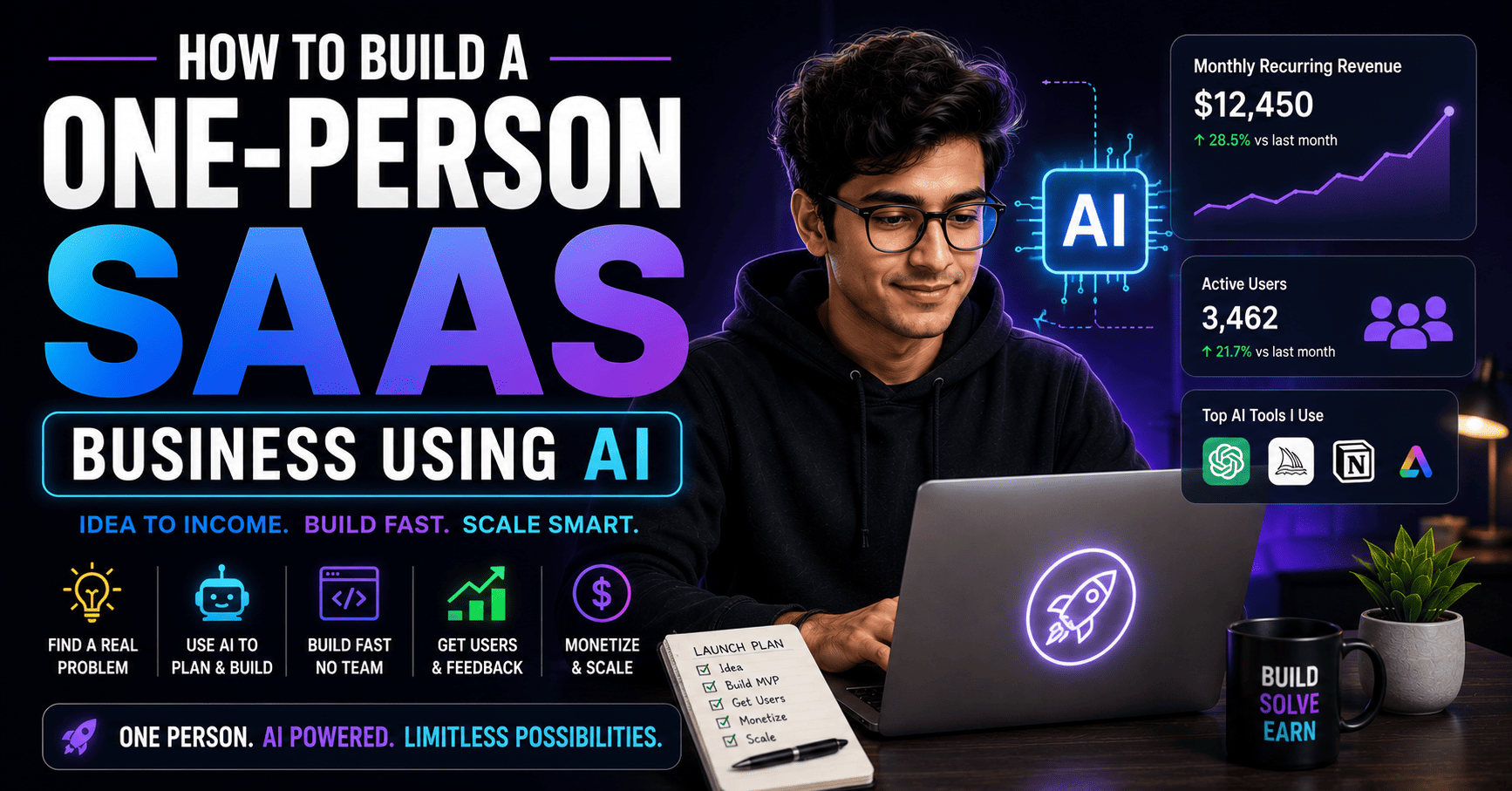
How to Build a One-Person SaaS Business Using AI
The era of needing a co-founder, a development agency, and $100,000 in funding to launch a software company is over. Today, one person with the right AI workflow can build, market, automate, and scale a profitable SaaS business faster than many funded startups.
That’s the real opportunity behind learning how to build a one-person SaaS business using AI.
The smartest solo founders in 2026 are no longer competing on team size. They compete on speed, distribution, automation, and niche focus. AI handles coding, customer support, onboarding, marketing drafts, analytics, and even product research. Your job becomes decision-making and execution.
I’ve noticed something interesting while analyzing dozens of indie SaaS launches: the successful one-person founders rarely build “big startup ideas.” Instead, they solve painfully specific problems for a clearly defined audience.
This guide breaks down exactly how to do that.
Why AI Changed the SaaS Game Forever
Five years ago, a solo SaaS founder needed:
Developers
Designers
Copywriters
Support staff
Marketing specialists
Now AI tools replace 70–80% of those early-stage tasks.
You can:
Generate MVP code using AI coding assistants
Create landing pages in hours
Automate customer onboarding
Write SEO content at scale
Analyze user feedback instantly
Build internal workflows without hiring
The result? A solo founder can realistically reach $5,000–$50,000/month recurring revenue without a traditional startup team.
That’s why “micro SaaS” businesses are exploding right now.
The Solo SaaS AI Stack (The S.A.A.S. Method)
Most people fail because they use AI randomly. Instead, you need a repeatable system.
Here’s the framework I call the S.A.A.S. Method:
Stage | Goal | Best AI Tools |
|---|---|---|
S – Spot Problems | Find profitable pain points | ChatGPT, Reddit analysis, Google Trends |
A – Assemble MVP Fast | Build quickly without perfection | Cursor, Replit, Lovable, Bolt |
A – Automate Everything | Reduce manual operations | Zapier, Make, AI agents |
S – Scale Through Content | Grow traffic and recurring users | SEO AI tools, email AI systems |
This is the exact model many successful indie hackers unknowingly follow.
Step 1: Find a Small but Painful Problem
This is where most solo founders fail.
They build broad products like “project management software” or “AI CRM.”
Bad idea.
A one-person SaaS wins by going narrow.
Instead of:
“Social media scheduler”
Build:
“Instagram caption planner for real estate agents”
Instead of:
“Email automation tool”
Build:
“Cold outreach follow-up system for recruiters”
Specificity wins because:
Lower competition
Easier SEO
Faster product-market fit
Simpler marketing
The AI-Powered Problem Discovery Process
Use AI to analyze:
Reddit complaints
Facebook group discussions
Product Hunt reviews
G2 review frustrations
YouTube comments
Ask AI:
What repetitive tasks exist?
What spreadsheets are businesses relying on?
What manual workflows waste time?
What software do people hate using?
The best SaaS ideas often sound boring.
Boring software makes money.
Step 2: Validate Before Building
Most SaaS founders waste months building products nobody wants.
Instead, validate demand in 72 hours.
The Fast Validation Formula
Create:
A landing page
A waitlist form
A simple product explanation
One demo mockup
Then test traffic using:
Reddit posts
LinkedIn content
Facebook communities
Short-form video
SEO articles
If nobody signs up, don’t build.
One of the biggest myths in SaaS is “build first, market later.” In reality, modern solo founders market before writing serious code.
What Good Validation Looks Like
You want:
Email signups
Demo requests
People asking questions
Users requesting features
Pre-orders if possible
Even 20–30 highly targeted signups can validate a niche SaaS idea.
Step 3: Build an MVP Using AI
This is where AI becomes your unfair advantage.
You no longer need to become a senior engineer before launching.
Best AI Tools for Solo SaaS Founders
AI Coding
OpenAI GPT-based coding assistants
Replit
Cursor
Bolt
Design
Figma AI
Framer AI
Canva AI
Backend & Automation
Supabase
Firebase
Zapier
Make
Payments
Stripe
You can now build a usable SaaS MVP in days instead of months.
Focus on One Core Outcome
Don’t build 20 features.
Build ONE thing extremely well.
For example:
Generate invoices automatically
Summarize meeting notes
Convert podcasts into blog posts
Track local SEO rankings
That’s enough for version one.
The fastest-growing SaaS businesses often start embarrassingly simple.
Step 4: Build Distribution Before Scaling Features
Most SaaS founders obsess over product quality while ignoring traffic.
That’s backwards.
A mediocre product with strong distribution beats a great product nobody discovers.
The One-Person SaaS Traffic Engine
Here’s the modern growth stack:
Channel | Why It Works |
|---|---|
SEO blogs | Compounds over time |
YouTube tutorials | High trust |
LinkedIn posts | B2B reach |
X/Twitter threads | Founder branding |
Email newsletters | Retention |
Programmatic SEO | Massive long-tail traffic |
SEO Is Still the Best Long-Term Channel
If you’re building a SaaS business in 2026, SEO remains one of the highest ROI channels because:
AI Overviews still cite authoritative content
Long-tail keywords convert extremely well
Niche queries are less competitive
Write content around:
“How to solve [specific problem]”
“[Tool] alternatives”
“[Industry] automation”
“[Workflow] templates”
This strategy alone can generate your first 100 paying users.
Step 5: Automate Operations with AI
The goal of a one-person SaaS business is not “doing everything yourself forever.”
The goal is creating leverage.
That means automating aggressively.
What You Should Automate Immediately
Customer Support
Use AI chatbots for:
FAQs
Onboarding
Troubleshooting
Billing questions
Content Marketing
AI can help:
Generate blog outlines
Repurpose videos into articles
Write email drafts
Create social media posts
Analytics
Use AI dashboards to:
Detect churn risks
Analyze customer behavior
Identify feature requests
Predict cancellations
Internal Workflows
Automate:
User onboarding
Trial reminders
Payment follow-ups
CRM updates
A strong automation setup can let one founder manage thousands of users.
Common Mistakes That Kill One-Person SaaS Businesses
1. Building Too Broad
The broader the market, the harder the competition.
Niche down harder than feels comfortable.
2. Overengineering the Product
Users care about outcomes, not technical complexity.
Simple products with clear value win.
3. Ignoring Distribution
A SaaS without traffic is just an expensive hobby.
Marketing starts before development.
4. Competing With Giant Companies
Never try to beat massive SaaS companies directly.
Instead:
Serve underserved niches
Offer simpler workflows
Focus on speed
Create better onboarding
5. Refusing to Charge Early
Charge sooner than you think.
Free users rarely give useful validation.
How Much Money Can a Solo SaaS Make?
The answer depends on niche, pricing, and distribution.
Here’s a realistic breakdown:
Stage | Revenue Range |
|---|---|
First 3 months | $0–$1,000 MRR |
6–12 months | $2,000–$10,000 MRR |
1–3 years | $20,000–$100,000+ MRR |
Some solo founders build life-changing businesses with fewer than 500 customers.
The real power of SaaS is recurring revenue.
Even a $49/month tool with 300 customers generates nearly $15,000 monthly recurring revenue.
That’s why small SaaS products can become incredibly profitable.
The Future of One-Person SaaS Businesses
Here’s what most people still underestimate:
AI is not replacing solo founders.
AI is creating more solo founders.
The next generation of SaaS businesses will look different:
Smaller teams
Faster launches
Niche products
AI-native workflows
Automated operations
The founders who win won’t necessarily be the best programmers.
They’ll be the best:
Problem finders
Audience builders
Workflow designers
AI operators
That’s the shift happening right now.
Your 30-Day One-Person SaaS Launch Plan
Week 1
Research niche problems
Analyze communities
Validate demand
Week 2
Build MVP
Create landing page
Set up payments
Week 3
Publish SEO content
Launch on social platforms
Collect feedback
Week 4
Improve onboarding
Automate workflows
Acquire first paying customers
Speed matters more than perfection.
The founders who launch fastest learn fastest.
Conclusion
Learning how to build a one-person SaaS business using AI is less about technology and more about leverage.
You don’t need:
Venture capital
Large teams
Fancy offices
Perfect code
You need:
A painful niche problem
Fast validation
Simple execution
Consistent distribution
Aggressive automation
That combination is powerful enough to build a real business in 2026.
The biggest advantage solo founders have today is speed. Large companies move slowly. You don’t have to.
Start smaller than you think.
Launch earlier than you’re comfortable with.
Automate sooner than feels necessary.
That’s the modern SaaS playbook.
FAQ
Can one person really build a SaaS business?
Yes. AI tools now handle coding, design, support, and automation tasks that previously required entire teams.
What is the best niche for a one-person SaaS?
The best niches solve repetitive business problems for specific industries like recruiters, agencies, accountants, marketers, or creators.
Do I need coding skills to build a SaaS with AI?
Basic technical understanding helps, but modern AI coding tools dramatically reduce the need for advanced programming skills.
How long does it take to make money from SaaS?
Many solo founders reach their first paying customers within 30–90 days if they validate demand properly and focus on distribution.
What is the cheapest way to build a SaaS MVP?
Using AI coding tools, no-code platforms, and cloud infrastructure can reduce MVP costs to under $500.
Is SEO important for SaaS businesses?
Absolutely. SEO provides long-term recurring traffic and high-intent users searching for solutions.
Can AI completely run a SaaS business?
Not entirely. AI automates operations, but strategic decisions, positioning, customer understanding, and product direction still require human judgment.