
 Continue with Google
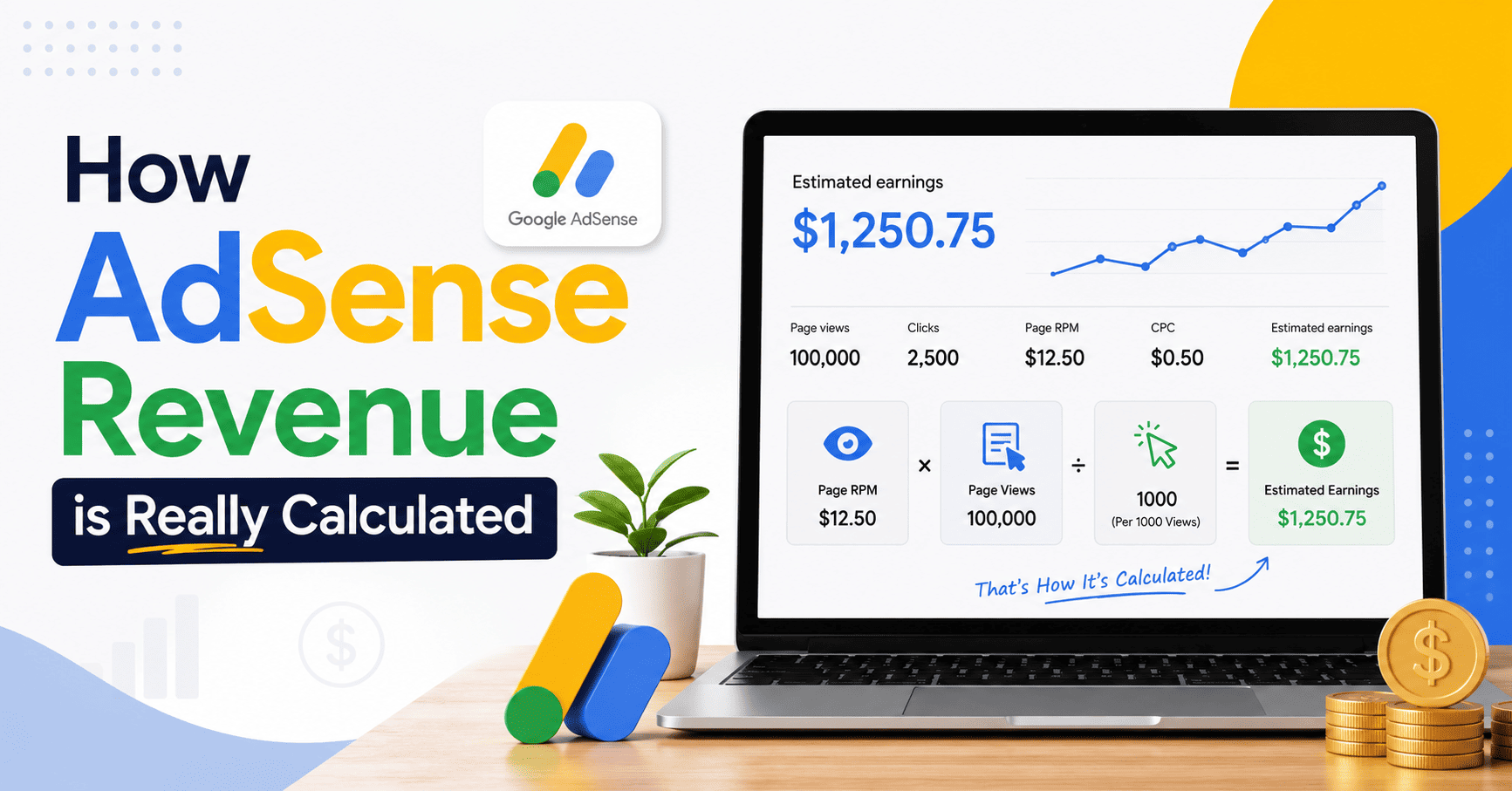
ow AdSense Revenue Is Really Calculated
Most website owners think AdSense revenue works like this:
More pageviews = more money.
That’s only partially true.
Two websites can generate:
the exact same traffic,
yet one earns:10x more revenue.
Why?
Because AdSense earnings depend on far more than traffic alone.
In 2026, publishers who understand how AdSense revenue is actually calculated have a major advantage. They optimize:
audience quality,
ad placement,
user behavior,
and monetization efficiency
instead of obsessing only over pageviews.
This guide breaks down how AdSense revenue really works — without the confusing technical jargon most articles use.
What Determines AdSense Revenue?
AdSense revenue is influenced by several connected metrics working together.
The biggest factors include:
CPC (Cost Per Click)
RPM (Revenue Per Mille)
CTR (Click-Through Rate)
Traffic quality
Audience location
Ad visibility
Niche competition
Google’s system evaluates all of these dynamically in real time.
That’s why earnings fluctuate daily even when traffic stays stable.
The Core AdSense Revenue Formula
At the simplest level, AdSense earnings are generally influenced by:
Revenue=Traffic×CTR×CPCRevenue = Traffic \times CTR \times CPCRevenue=Traffic×CTR×CPC
Here’s what each part means:
Metric | Meaning |
|---|---|
Traffic | Total visitors or pageviews |
CTR | Percentage of users clicking ads |
CPC | Amount earned per ad click |
But modern AdSense monetization is far more advanced than this simplified formula.
Today, Google also factors in:
advertiser demand,
audience intent,
ad auctions,
device type,
and user engagement signals.
What Is CPC in AdSense?
CPC stands for:
Cost Per Click
This measures how much advertisers pay when someone clicks an ad.
Example
If advertisers bid:
$2 per click
and your site generates:100 valid clicks,
your estimated earnings could be:
$200 before platform adjustments.
But CPC varies massively depending on niche.
High CPC Niches in 2026
Some industries attract premium advertising budgets because customers are highly valuable.
High CPC Categories
Insurance
Finance
SaaS
AI software
Legal services
Real estate
Business tools
Investing
Certain finance keywords can exceed:
$20–$80 CPC
because advertisers compete aggressively for customers.
What Is CTR?
CTR stands for:
Click-Through Rate
This measures the percentage of users who click on ads.
CTR Formula
CTR=ClicksImpressions×100CTR = \frac{Clicks}{Impressions} \times 100CTR=ImpressionsClicks×100
Example:
10,000 ad impressions
150 clicks
Results in:
1.5% CTR
CTR matters because even high CPC websites struggle if nobody clicks ads.
Why User Intent Matters More Than Traffic
This is where many publishers misunderstand AdSense completely.
Google values:
buyer intent,
not just traffic volume.
Example
A website ranking for:
“best business credit cards”
will usually earn far more than:
celebrity gossip traffic.
Why?
Because advertisers pay more when users are closer to making purchasing decisions.
Intent-driven traffic often generates:
higher CPC,
better CTR,
and stronger RPM.
That combination dramatically increases earnings.
What Is RPM in AdSense?
RPM stands for:
Revenue Per Mille
“Mille” means 1,000.
RPM measures how much revenue you earn per:
1,000 pageviews.
RPM Formula
RPM=Estimated EarningsPageviews×1000RPM = \frac{Estimated\ Earnings}{Pageviews} \times 1000RPM=PageviewsEstimated Earnings×1000
RPM is one of the most important metrics because it reflects actual monetization performance.
Why RPM Matters More Than Pageviews
Many publishers chase traffic obsessively.
But RPM determines:
how efficiently you monetize that traffic.
Example
| Website | Monthly Traffic | RPM | Revenue |
|---|---|---|
| Site A | 500,000 views | $2 RPM | $1,000 |
| Site B | 100,000 views | $25 RPM | $2,500 |
The smaller site earns more despite far less traffic.
That’s why experienced publishers focus heavily on:
traffic quality,
audience intent,
and monetization efficiency.
Hidden Factors Affecting AdSense Revenue
Most basic guides ignore these important variables.
1. Audience Geography
Traffic from:
the US,
UK,
Canada,
and Australia
usually earns more than lower-income regions because advertisers spend more aggressively there.
2. Device Type
Desktop traffic often generates higher RPM than mobile traffic in certain niches because users convert better.
3. Ad Placement
Poor ad placement reduces:
visibility,
engagement,
and CTR.
But excessive ads hurt:
user experience,
SEO,
and retention.
Smart publishers balance monetization with usability.
4. Content Length and Engagement
Longer engagement sessions often increase:
ad impressions,
viewability,
and total earnings.
High-quality content indirectly improves monetization.
Why AdSense Earnings Fluctuate Daily
Publishers often panic when earnings change suddenly.
But fluctuations are normal.
AdSense revenue changes because:
advertiser demand changes,
ad auctions shift,
seasonal budgets fluctuate,
and audience behavior evolves constantly.
Seasonal Trends
CPMs and RPMs often rise during:
Black Friday,
Q4 holiday seasons,
and year-end advertising periods.
January frequently sees lower earnings because advertisers reduce budgets after the holidays.
The Biggest AdSense Mistakes Publishers Make
1. Chasing Viral Traffic
Low-intent viral traffic usually monetizes poorly.
Targeted traffic often earns far more.
2. Ignoring SEO Intent
Keywords with commercial intent generally produce better RPM.
3. Overloading Ads
Too many ads can reduce:
page speed,
user trust,
and long-term growth.
4. Depending Only on AdSense
The highest-earning publishers diversify income using:
affiliate marketing,
sponsorships,
digital products,
and subscriptions.
AdSense works best as one revenue layer — not the entire business model.
The Future of AdSense Monetization
AdSense is becoming more intelligent every year.
Google increasingly evaluates:
content quality,
audience engagement,
user satisfaction,
and advertiser performance signals.
This means low-quality, AI-spam websites are struggling more after recent algorithm updates.
Meanwhile, authority-driven websites with:
strong EEAT,
helpful content,
and niche expertise
continue performing well.
The future belongs to publishers who combine:
SEO,
audience trust,
and monetization strategy intelligently.
Final Thoughts
AdSense revenue is not random.
It’s the result of multiple interconnected factors:
traffic quality,
user intent,
CPC,
CTR,
RPM,
and advertiser demand.
Understanding these metrics changes how you approach content creation entirely.
Instead of chasing empty pageviews, smart publishers focus on:
profitable audiences,
commercial intent,
and sustainable monetization systems.
Because in 2026, the publishers earning the most are not always the ones with the biggest traffic.
They’re the ones monetizing intelligently.
FAQ: How AdSense Revenue Is Calculated
What affects AdSense earnings the most?
The biggest factors include CPC, CTR, RPM, audience location, niche competition, and user intent.
Why do some websites earn more with less traffic?
High-quality traffic with strong commercial intent often generates higher RPM and CPC.
What is a good AdSense RPM?
RPM varies by niche, but many publishers target:
$5–$30 RPM depending on audience quality.
Why are finance websites so profitable?
Finance advertisers pay premium rates because customer acquisition value is extremely high.
Does traffic location matter for AdSense?
Yes. Traffic from high-income countries generally earns significantly more.
Can AI-generated content hurt AdSense revenue?
Low-quality AI content can reduce rankings, engagement, and monetization performance after modern Google updates.