
 Continue with Google
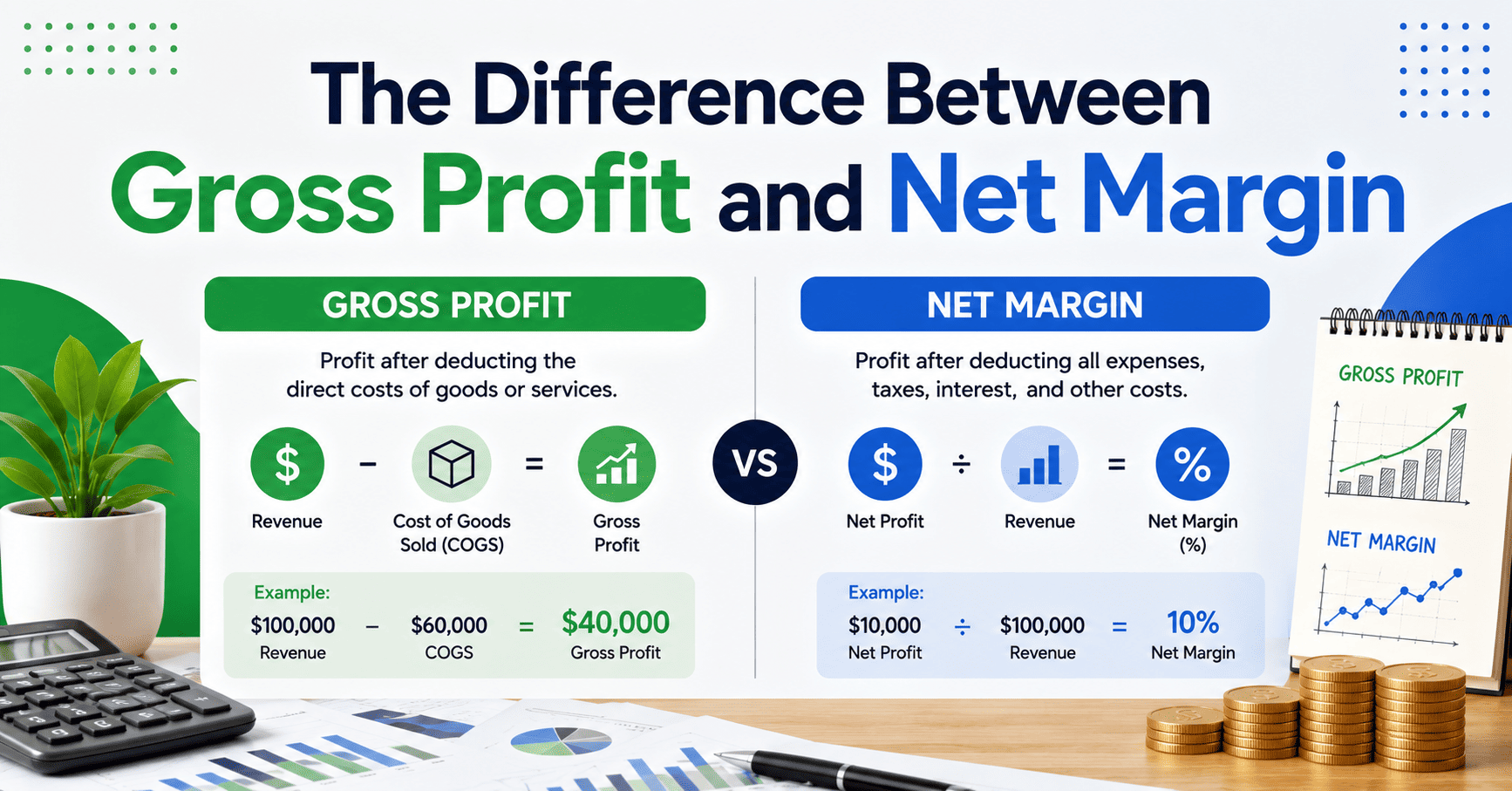
The Difference Between Gross Profit and Net Margin
Many business owners think revenue tells the full story.
It doesn’t.
A company can generate:
millions in sales,
while still struggling financially.
Why?
Because revenue without profitability means very little.
That’s where two critical financial metrics come in:
gross profit
and net margin.
These numbers help businesses understand:
how efficiently they operate,
where money is leaking,
and whether growth is actually sustainable.
The problem is that many entrepreneurs confuse the two — or focus entirely on one while ignoring the other.
In reality, gross profit and net margin measure completely different aspects of financial health.
This guide explains the difference between gross profit and net margin in simple language, including how they’re calculated, why they matter, and what smart businesses focus on in 2026.
What Is Gross Profit?
Gross profit measures:
how much money a business keeps after subtracting the direct costs of producing goods or services.
These direct costs are called:
Cost of Goods Sold (COGS).
COGS can include:
manufacturing costs,
raw materials,
shipping,
labor directly tied to production,
or service delivery expenses.
Gross Profit Formula
Gross Profit=Revenue−Cost of Goods SoldGross\ Profit = Revenue - Cost\ of\ Goods\ SoldGross Profit=Revenue−Cost of Goods Sold
Example
Imagine an online clothing store generates:
$100,000 in sales.
The cost to manufacture and deliver products is:
$40,000.
The gross profit would be:
100,000−40,000=60,000100,000 - 40,000 = 60,000100,000−40,000=60,000
Gross profit:
$60,000
This tells us the company retains:
$60,000 before operating expenses and taxes.
What Gross Profit Actually Reveals
Gross profit measures:
production efficiency.
It helps businesses answer:
“Are we making enough money from our core product or service?”
A strong gross profit usually indicates:
healthy pricing,
efficient production,
and good cost control.
What Is Net Margin?
Net margin measures:
how much profit a company keeps after ALL expenses are deducted.
Unlike gross profit, net margin includes:
salaries,
rent,
software,
taxes,
advertising,
interest,
operational costs,
and other business expenses.
This makes net margin one of the clearest indicators of true profitability.
Net Margin Formula
Net Margin=Net ProfitRevenue×100Net\ Margin = \frac{Net\ Profit}{Revenue} \times 100Net Margin=RevenueNet Profit×100
Example
Using the same company:
Revenue:
$100,000
After all expenses, total net profit becomes:
$15,000
Net margin would be:
15,000100,000×100=15%\frac{15,000}{100,000} \times 100 = 15\%100,00015,000×100=15%
Net margin:
15%
This means the business keeps:
15 cents for every dollar earned.
Gross Profit vs Net Margin: The Core Difference
Here’s the simplest breakdown:
Metric | Measures | Focus |
|---|---|---|
Gross Profit | Revenue after direct costs | Product efficiency |
Net Margin | Final profit after all expenses | Overall business profitability |
Gross profit looks at:
production performance.
Net margin looks at:
complete business health.
Both matter — but they answer different questions.
Why Businesses Confuse These Metrics
Many companies celebrate strong revenue and gross profit numbers while ignoring operational inefficiencies.
That creates dangerous blind spots.
Example
A SaaS company might have:
excellent gross profit margins
because software scales cheaply.
But if the business spends excessively on:
ads,
salaries,
or expansion,
its net margin could still become weak.
This is why investors and experienced operators analyze both metrics together.
Why Gross Profit Matters in 2026
In modern business, rising costs are putting pressure on margins everywhere.
Companies dealing with:
inflation,
supply chain issues,
and increasing acquisition costs
must monitor gross profit carefully.
Strong Gross Profit Creates Flexibility
Businesses with healthy gross profit can:
reinvest aggressively,
survive market downturns,
and scale faster.
Low gross profit businesses often struggle because there’s little financial room for mistakes.
Why Net Margin Matters Even More
A business can survive weak growth temporarily.
It cannot survive poor profitability forever.
Net margin reveals:
operational discipline.
It shows whether a company:
spends wisely,
scales efficiently,
and maintains sustainable economics.
The Hidden Growth Trap
Many startups chase:
revenue growth at all costs.
But high revenue with poor net margins often creates:
cash flow problems,
investor pressure,
and unstable operations.
Smart businesses prioritize:
profitable growth.
Not just bigger numbers.
Industries With Different Margin Structures
Not all industries operate the same way.
High Gross Margin Industries
These industries often retain more revenue after direct costs:
SaaS
Digital products
Online education
Software companies
Consulting
Digital businesses scale efficiently because delivery costs stay relatively low.
Lower Gross Margin Industries
These industries usually face heavier operational costs:
retail,
manufacturing,
restaurants,
logistics,
and ecommerce.
Margins tend to be tighter because physical goods involve:
inventory,
shipping,
labor,
and supply chain expenses.
The P.R.O.F.I.T Framework for Margin Improvement
The smartest companies improve margins strategically.
That’s where the P.R.O.F.I.T Framework comes in.
P — Price Strategically
Underpricing destroys profitability.
Many businesses focus on volume instead of value.
R — Reduce Operational Waste
Inefficient processes quietly erode margins over time.
O — Optimize Customer Acquisition
Lower marketing costs improve net margins dramatically.
F — Focus on High-Margin Products
Not all products contribute equally to profits.
Premium offerings often improve margin efficiency.
I — Increase Retention
Retaining customers is usually cheaper than acquiring new ones.
T — Track Metrics Consistently
Businesses that monitor margins regularly make smarter financial decisions.
Common Financial Mistakes Businesses Make
1. Obsessing Over Revenue
Revenue sounds impressive.
Profitability determines survival.
2. Ignoring Hidden Costs
Software subscriptions, payroll expansion, and advertising creep can destroy net margins slowly.
3. Scaling Too Fast
Rapid growth without financial discipline often creates unstable businesses.
4. Misunderstanding Profitability
Some businesses assume high gross profit automatically means strong financial health.
That’s not always true.
Which Metric Is More Important?
The answer depends on what you’re analyzing.
Focus on Gross Profit When:
evaluating product pricing,
production efficiency,
or delivery costs.
Focus on Net Margin When:
measuring overall business sustainability,
operational performance,
and profitability.
In reality:
the strongest businesses optimize both.
Final Thoughts
Gross profit and net margin are not competing metrics.
They work together to reveal:
how efficiently a business operates,
how sustainably it grows,
and how financially healthy it truly is.
Gross profit shows:
how well your products perform.
Net margin shows:
how well your business performs overall.
Understanding both metrics helps entrepreneurs make smarter decisions about:
pricing,
scaling,
hiring,
operations,
and growth strategy.
Because in 2026, sustainable businesses are no longer built on revenue hype alone.
They’re built on profitable systems.
FAQ: Gross Profit vs Net Margin
What is the difference between gross profit and net margin?
Gross profit measures revenue after direct production costs, while net margin measures final profitability after all expenses.
Why is net margin important?
Net margin shows how efficiently a business converts revenue into actual profit.
Can a company have high gross profit but low net margin?
Yes. High operating expenses can reduce overall profitability despite strong gross profit.
Which industries have the highest gross margins?
Software, SaaS, online education, and digital product businesses often have high gross margins.
Is revenue more important than profit?
Revenue drives growth, but profit determines long-term sustainability.
What is considered a good net margin?
It varies by industry, but many healthy businesses target:
10%–20% net margins or higher.